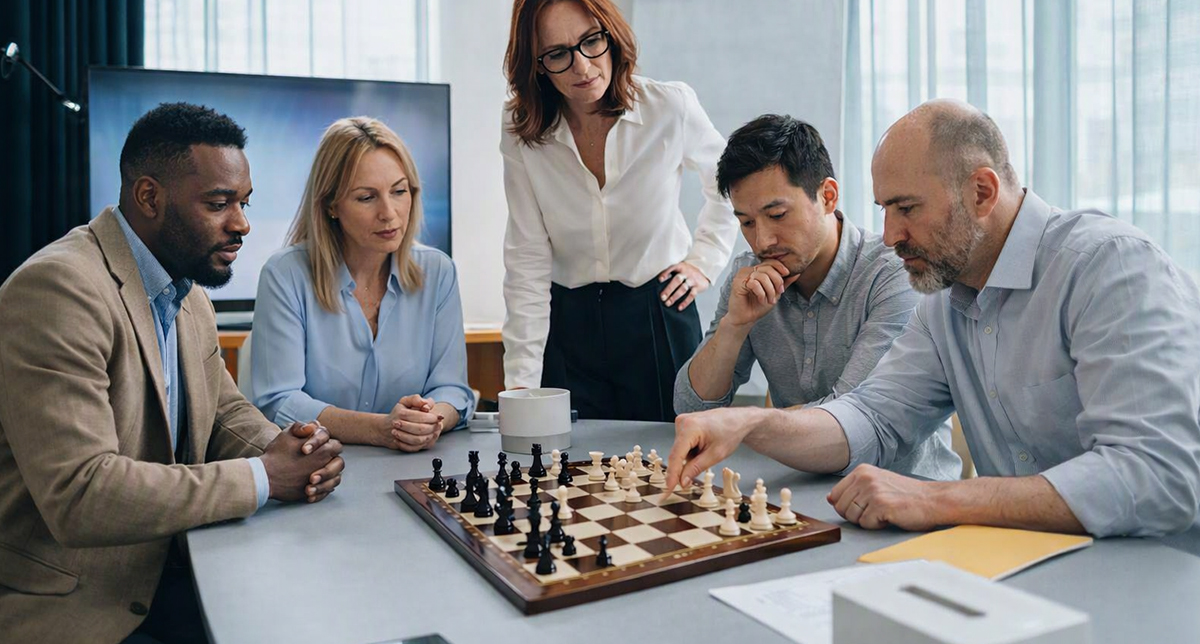
You sit in the meeting while executives discuss direction, market positioning, and long-term plans. Your insights about the operations you manage could reshape their thinking. But you are not asked. You are not at that table. The conversation moves forward without you.
This happens to capable professionals every day. They excel at their current role but feel trapped by an invisible ceiling. They watch less experienced people rise because those people seem to have something they lack: strategic vision.
Here is what most people get wrong: strategic thinking is not an innate talent reserved for a gifted few. It is a learnable skill that develops through exposure, practice, and deliberate learning.
What Strategic Thinking Actually Is
Strategic thinkers ask different questions than tactical thinkers. Instead of “How do we execute this project well?”, they ask “Why are we doing this project and what does success mean for the organization?”. Instead of “What keeps us busy?”, they ask “What moves us toward our goals?”.
The difference is perspective and training, not innate ability.
Why People Believe It Is Innate
The myth of innate strategic thinking persists because successful strategists make it look effortless.
We see a CEO make a brilliant decision and assume they were born with that insight. What we do not see is the decade of decisions, analysis, patterns recognized, and lessons learned that preceded that moment.
You can build the same capability.
How Strategic Thinkers Develop Their Skills
Strategic professionals share common practices. They study market trends obsessively, not passively. They understand their industry landscape, competitor moves, customer behavior shifts, and economic factors. This awareness trains their pattern recognition.
They also analyze decisions in retrospect. After major projects or market moves conclude, they ask what signals they missed, what they predicted correctly, and what assumptions proved wrong. This reflection accelerates learning.
Successful strategic thinkers also engage cross-functionally. They talk to finance, sales, operations, and marketing to understand how different parts of the organization work together. This systems thinking is fundamental to strategy.
They read business case studies and history. Learning how other organizations navigated similar challenges builds a mental library of strategic possibilities and pitfalls.
Finally, they receive coaching and training that accelerates their development. Rather than learning strategy only through trial and error over decades, they study frameworks, methodologies, and approaches that compress years of learning into months.
Your Path to the Strategy Table
The professionals who occupy strategy conversations are not smarter than you. They simply developed a skill you have not yet built. That is fixable.
Strategic Thinking and Business Planning for Results provides exactly the frameworks, tools, and perspectives that transform tactical operators into strategic thinkers. It teaches you how successful organizations think about competitive advantage, market dynamics, and long-term positioning.
You have the capability to sit at the strategy table. You just need the training to bridge the gap between where you are and where you want to be.
That conversation about direction and positioning? Soon you will be contributing to it.
Learn Strategic Thinking and Business Planning
Full details on courses and dates are available at www.spearhead-training.com or by calling +971 4 336 2552.